Carrier HVAC Maintenance Calendar for Arcadia, CA
Last updated 2026-06-13.
Up front: Arcadia Carrier HVAC recommends two professional visits a year - a spring AC tune-up and a fall furnace tune-up - plus monthly filter checks, timed to Arcadia's Zone 9 foothill seasons across 91006 and Highland Oaks. Call (213) 766-5980 or book online; this calendar splits what you can do yourself from technician-only tasks.
Fast reference
- Two professional visits a year: spring AC, fall furnace.
- Filter: check monthly in cooling season, change every 1 to 3 months.
- Spring matters most here - the cooling season is long and heat-driven failures dominate.
- DIY-safe: filters, gentle outdoor-coil rinse, clearing the condensate drain, keeping the condenser clear.
- Leave to a technician: refrigerant, electrical, evaporator coil, combustion, fault-code diagnosis.
- Maintenance supports Carrier's registered warranty expectations.
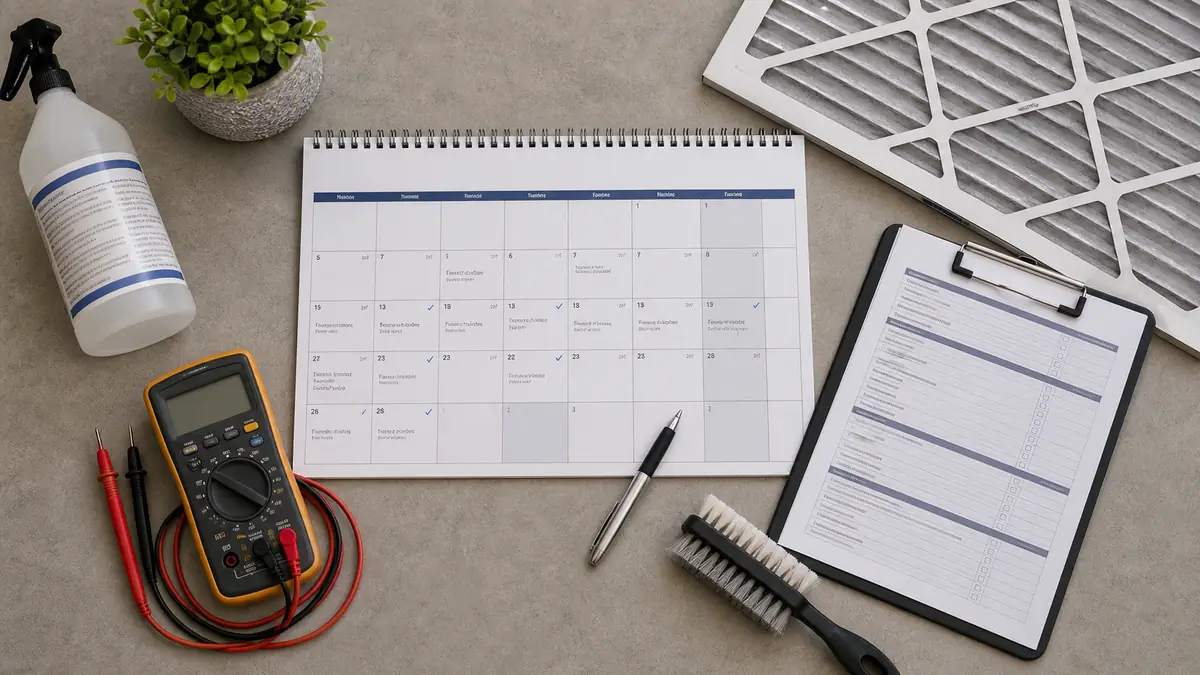
Why does Arcadia need its own calendar?
Generic HVAC checklists assume a cold-winter climate with a heating-dominant load. Arcadia is the opposite. Pressed into the San Gabriel foothills, the city falls in cooling-dominant Title-24 Climate Zone 9 and runs July highs around 91 to 95 F, roughly 45 to 65 days a year at or above 90 F, and frequent 100 F-plus Santa Ana spikes. The cooling system does the heavy lifting and fails under that load; the gas furnace works only a few months and gently. A maintenance calendar that fits Arcadia front-loads the cooling work in spring, treats filter discipline as the cheapest insurance against summer breakdowns, and keeps the fall furnace visit focused on the ignition train that sat idle all summer.
What should I do each season?
A handful of cheap habits prevent most emergency calls. Here is the season-by-season rhythm for a Carrier system in Arcadia, built around a long cooling season and a short, gentle heating one.
| Season | Do it yourself | Schedule a technician |
|---|---|---|
| Late winter / early spring (Feb-Apr) | Replace filter; clear leaves and debris from around the condenser; gently rinse the outdoor coil | Spring AC tune-up: capacitor reading, contactor, charge, coil clean, condensate drain |
| Summer (May-Sep) | Check filter monthly; keep two feet clear around the condenser; watch for weak cooling early | Address any short cycling or weak cooling fast, before peak heat strands you |
| Fall (Oct-Nov) | Replace filter; test smoke and CO detectors; clear return grilles | Fall furnace tune-up: igniter, flame sensor, inducer, pressure switch, safeties, flash codes |
| Winter (Dec-Jan) | Run the heat early to catch a no-start before a cold snap; keep vents unblocked | Diagnose any no-heat lockout codes (13, 31, 34) promptly |
What is the month-by-month task list for Zone 9?
Arcadia's Climate Zone 9 calendar is lopsided on purpose: the cooling work front-loads into late winter and spring, summer is monitoring, and the brief heating prep lands in fall. Here is the month-level breakdown we follow on Carrier systems across Highland Oaks, Baldwin Stocker, and Lower Rancho.
- January: Deep heating month for Arcadia. Run the furnace, listen for a rough inducer start, and replace the filter. If the burner short-cycles or flashes code 31 or 34, book the repair now while parts are easy to get.
- February: The cooling clock starts. Schedule the spring AC tune-up before the rush; this is when capacitor microfarad readings and a coil wash are cheapest and fastest to get on the calendar.
- March: Clear winter leaf litter and Arboretum cottonwood from the condenser, cut back shrubs to a two-foot clearance, and gently rinse the outdoor coil from the inside out with the disconnect pulled.
- April: Test cooling on the first warm afternoon before you actually need it. A weak capacitor caught in April is a routine $150 to $450 swap instead of a peak-season emergency.
- May: Fresh 1-inch filter for the cooling season; switch a thermostat schedule to your summer setpoints. Confirm the condensate drain runs free so a clog does not open the float switch in July.
- June through August: Check the filter monthly - more often near the Arboretum - and watch for early warning signs: longer run times, weak airflow, or a condenser that hums but is slow to start on 100 F Santa Ana afternoons. Address them the same week, not in the next heat wave.
- September: Cooling load is still high in the foothills; keep the filter fresh and the condenser clear of the season's dust.
- October: The pivot to heating. Replace the filter, test smoke and CO detectors, and book the fall furnace tune-up before the first cold morning exposes a dirty flame sensor.
- November: Run the heat early to surface any no-start, and clear return grilles that pick up dust in idle months.
- December: Keep supply and return vents unblocked by holiday furniture, and confirm the furnace lights cleanly on the first genuinely cold night.
What does the spring AC tune-up actually check?
The spring visit is built around the failures that strand Arcadia homes in July. We meter the dual-run capacitor against its microfarad rating and replace it if it is drifting, inspect the contactor for pitting, wash the condenser coil that has packed with foothill dust and Arboretum cottonwood, verify refrigerant charge and superheat, and clear and treat the condensate drain so a clog does not open the float switch mid-heat-wave. On an Infinity Greenspeed system we pull the fault history off the Infinity System Control to catch a developing comm or sensor issue. Catching a low capacitor in April turns a $400-plus emergency into a routine $150 to $450 scheduled fix.
What does the fall furnace tune-up check?
Arcadia furnaces sit unused all summer, so the first heating call of the season often trips on a dirty flame sensor (code 34) or a stuck pressure switch (code 31). The fall visit tests and cleans the hot-surface igniter and flame sensor, checks the inducer and pressure switch, verifies the high-limit and rollout safeties, and reads the control-board flash codes. On the 80 percent 58-series furnaces common in Arcadia ranch homes, this is also when we catch an aging igniter or inducer before it fails on the first cold night. If a rollout code 26 appears, we inspect the heat exchanger as a carbon-monoxide safety check.
Which tasks are safe for me, and which are not?
| Task | Who | Why |
|---|---|---|
| Replace air filter | You | Cheap, frequent, prevents frozen coils and limit lockouts |
| Rinse outdoor coil (power off, low pressure) | You | Improves heat rejection; never use a pressure washer |
| Clear condensate drain access / keep pan dry | You | Prevents float-switch shutdowns |
| Refrigerant charge, leak repair | Technician | EPA-regulated, needs gauges and recovery |
| Capacitor, contactor, board work | Technician | Stored charge and 240V hazards |
| Combustion, heat exchanger, gas valve | Technician | CO and gas safety |
What filter should an Arcadia home run, and how often?
Filter discipline is the single cheapest thing that prevents frozen coils and limit-lockout no-heat calls, but the wrong filter causes the same airflow problems it is supposed to avoid. On a standard 1-inch Carrier filter slot, a MERV 8 to 11 pleated filter is the practical sweet spot for Arcadia: enough filtration to keep the evaporator coil and blower clean without choking airflow on the tight 1950s ranch ductwork common here. A dense MERV 13 in a 1-inch slot can starve a Carrier coil enough to ice it, so if you want hospital-grade filtration the right move is a 4-inch media cabinet sized for the airflow, not a thicker 1-inch filter. Check the filter monthly during the long cooling season and change a 1-inch filter every 1 to 3 months - sooner near the Arboretum, where cottonwood and pollen load the air, or with pets in the home.
Diagnostic case scenario (illustrative)
This is an illustrative example, not a customer review. A Baldwin Stocker ranch home calls in mid-July because the AC runs constantly but the back bedrooms never cool below 80 F. On arrival the filter is gray and packed, the return is a single undersized grille, and the evaporator coil shows light frost. The owner had skipped the spring tune-up. A tech replaces the filter, lets the coil thaw with the fan running, washes a condenser coil caked with foothill dust, and meters the dual-run capacitor at 32 microfarads against a 40 rating - drifting and due to fail. Swapping the capacitor and clearing the airflow restriction restores full cooling in one visit. The lesson the calendar teaches: a February tune-up and monthly filter checks would have caught the weak capacitor in spring and prevented the iced coil entirely, turning a stressful peak-heat call into routine maintenance.
Does maintenance protect my Carrier warranty?
Carrier's registered parts warranty generally expects documented annual maintenance, and a gap can complicate a future claim. We keep a dated service record you can hand to Carrier's authorized service if a warranty repair is ever needed, which protects coverage on newer Infinity and Performance equipment. If your unit is still in warranty and a sealed-system part fails, the claim runs through authorized service first - we will tell you when that is the right call. For ongoing coverage, see our maintenance plans.
Bottom line for an Arcadia Carrier system
- Book the spring AC tune-up in February to April and the fall furnace tune-up in October - two visits a year, timed to Zone 9 seasons.
- Check the filter monthly in cooling season; run MERV 8 to 11 in a 1-inch slot, change every 1 to 3 months.
- If you only do one professional visit, make it spring AC - the cooling load drives nearly all the failures here.
- Keep two feet clear around the condenser and rinse the coil gently with the power off; never use a pressure washer.
- Leave refrigerant, electrical, combustion, and the evaporator coil to a technician; a code 26 rollout means stop and inspect.
- Keep a dated service record to support Carrier's registered warranty expectations.
Common questions
How often should an Arcadia Carrier system be professionally serviced?
Twice a year is the standard that matches Arcadia's two real seasons: a spring AC tune-up before the first 90 F stretch and a fall furnace tune-up before cold mornings. If you only do one, make it the spring AC visit, because the cooling load here is far heavier than the heating load and most failures strike in summer.
How often should I change my filter in Arcadia?
Check it monthly during the long cooling season and change a 1-inch filter every 1 to 3 months, sooner if you are near the Arboretum where cottonwood and pollen load the air, or if you have pets. A packed filter is the most common cause of frozen coils and limit-lockout no-heat calls, so this one cheap habit prevents real failures.
Can I clean my own Carrier condenser coil?
You can gently rinse the outdoor coil from the inside out with a garden hose on low pressure after killing power at the disconnect - never a pressure washer, which bends the fins. Leave refrigerant, electrical, and the indoor evaporator coil to a technician. The annual deep clean and charge check is part of the spring visit.
Is a maintenance plan worth it for an Arcadia home?
For most Arcadia homes, yes, because the cooling season is long and heat-driven failures cluster on the worst days. A plan bundles the spring AC and fall furnace visits, keeps a dated service record for warranty claims, and usually prioritizes you during heat-wave backlogs when same-day slots vanish. If you reliably book both visits yourself and change filters on schedule, you can self-manage - the plan mainly buys convenience and a documented history.
When should I schedule the spring tune-up to beat the rush?
February to early April. Booking the AC tune-up before the first 90 F stretch means a weak capacitor or low charge gets caught while the schedule is open and parts are easy to source. Wait until the first July heat wave and you are competing with every other no-cool call in the 91006 and 91007 ZIPs for the same day's slots.
Related: maintenance plans, repair or replace, buying guide, and AC repair.