Carrier Furnace Not Heating in Arcadia, CA
Up front: Arcadia Carrier HVAC diagnoses no-heat calls on 58/59-series Carrier furnaces across Arcadia 91006 and Highland Oaks by reading the amber flash code on the control board. Call (213) 766-5980 or book online; codes 13, 31, and 34 cover most no-heat faults, with flame-sensor or igniter repairs near $150 to $400.
Fast reference
- Carrier furnaces flash a two-digit code on an amber LED (short flashes then long).
- Most common no-heat causes: ignition (igniter/flame sensor), pressure switch, limit lockout.
- Code 13 = limit lockout (airflow); 31 = pressure switch; 34 = ignition proving; 14 = hard ignition lockout.
- Code 26 (rollout) means stop and inspect the heat exchanger - a CO safety concern.
- Flame-sensor or igniter repair lane: roughly $150 to $400; control board $400 to $2,000.
- Service area: Arcadia 91006, 91007, 91066, 91077. Hours: Mon-Fri 8am-6pm, Sat 9am-3pm.
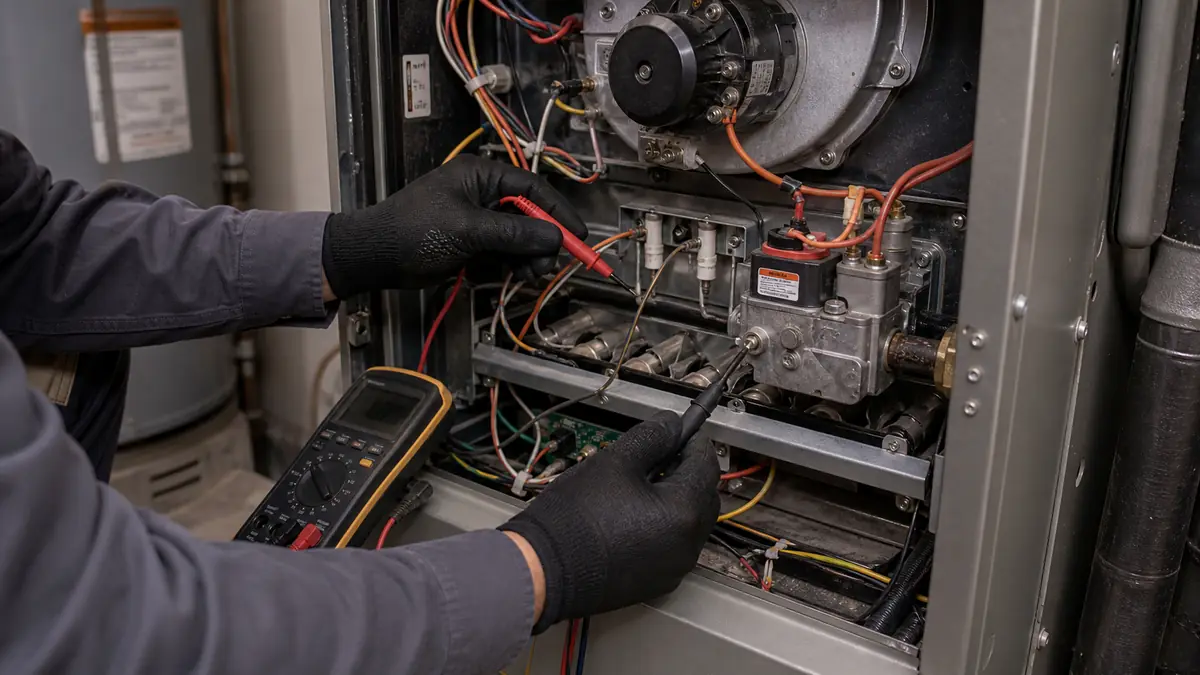
What can I check before calling?
Arcadia's heating season is short, so furnaces often sit idle for months and then refuse to start on the first cold morning. Before you call, confirm the thermostat is set to Heat with a setpoint above room temperature and good batteries, check that the furnace switch and breaker are on, and replace the filter - a clogged filter is the number-one cause of a furnace overheating and locking out on code 13. Then read the amber LED on the control board through the sight glass and count the flashes. That code tells us what to bring.
What do the Carrier furnace codes mean?
Carrier control boards report a two-digit code by flashing the amber LED - short flashes for the first digit, long for the second. Here are the no-heat codes that matter, with the typical 2026 SoCal repair lane:
| Code | Meaning / likely cause | Typical lane |
|---|---|---|
| 13 | Limit lockout - overheating from restricted airflow | Filter/blower; $0 to ~$600 |
| 14 | Hard ignition lockout - failed igniter, no gas, or no flame | $150 - $400 igniter |
| 31 | Pressure switch did not close - inducer or blocked flue | $150 - $500 |
| 33 | Limit circuit fault - recurrent overheating | Airflow/limit; varies |
| 34 | Ignition proving failure - dirty/weak flame sensor | $150 - $400 |
| 26 | Rollout switch - inspect heat exchanger (safety) | Stop; inspection first |
| 45 | Control circuitry lockout - board fault | $400 - $2,000 |
Why do these failures show up in Arcadia?
Two reasons. First, the long idle summer lets dust film the flame sensor and corrosion settle on contacts, so the first heating call of the season trips code 34. Second, many Arcadia ranch homes run on basic 80 percent furnaces (the 58-series) that are common and adequate in mild SoCal, and after 15-plus years their igniters, sensors, and inducers reach end of life together. We see clusters of the same three repairs every fall across Lower Rancho and Baldwin Stocker.
What is safe to check myself versus call a pro?
Two homeowner checks are safe and often solve the problem: confirm the thermostat is on Heat with good batteries and a setpoint above room temperature, and replace a clogged filter, which is the leading cause of a code 13 limit lockout. You can also reset the breaker once and read the amber flash code through the sight glass. Stop there. Anything past the cover - the gas valve, igniter, flame sensor, inducer, pressure switch, control board, and especially the heat exchanger - involves natural gas, line voltage, and carbon-monoxide risk and belongs to a technician. Never bypass a safety switch or repeatedly reset a furnace that keeps locking out; a switch is open because it is doing its job.
What does a no-heat repair cost in Arcadia?
Most no-heat fixes are not expensive. A dirty flame sensor or weak hot-surface igniter - the two most common first-call-of-the-season faults - runs roughly $150 to $400. A pressure-switch or inducer issue behind a code 31 lands around $150 to $500. A clogged filter causing a code 13 limit lockout can be a near-zero fix once the airflow is restored. The high end is a failed control board (code 45) at $400 to $2,000, and a code 26 rollout that reveals a cracked heat exchanger usually pushes an aging 58-series furnace into replacement territory rather than a repair - the safe answer, covered in the repair-or-replace guide.
When is no-heat a safety issue?
A code 26 rollout trip is the one to never ignore. It can mean a cracked or overheating heat exchanger, which can leak combustion gases including carbon monoxide into the home. Repeatedly resetting a furnace that keeps tripping a rollout or limit is genuinely dangerous. If you have working CO detectors and the furnace locks out on 26, shut it off and have it inspected. If the heat exchanger is compromised on an aging 58-series furnace, replacement is usually the right and safe answer - see the repair-or-replace guide.
Common questions
My Carrier furnace ignites then shuts off after a few seconds - why?
That short-cycle-on-ignition pattern on a 58/59-series furnace is classic code 34, ignition proving failure: the flame lights but the flame sensor does not confirm it, usually because the sensor is dirty or weak. Cleaning or replacing the flame sensor runs about $150 to $400 and fixes most of these. A weak igniter or a gas-supply issue causes a similar pattern.
What does a flashing 13 mean on my Carrier furnace?
Code 13 is a limit-circuit lockout - the furnace overheated and a safety opened. On Arcadia homes the cause is almost always restricted airflow: a clogged filter, a closed-up return, or a blower problem. Replace the filter and clear returns first; if it relocks, the blower or limit switch needs attention before it keeps tripping.
Should I worry about a code 26 on my Carrier furnace?
Yes - take code 26 seriously. It is a rollout switch trip, which can indicate a cracked or overheating heat exchanger or a serious combustion problem. Do not keep resetting it. Shut the furnace off and have it inspected, because a compromised heat exchanger is a carbon-monoxide risk, not just a comfort issue.
Related: AC short cycling, maintenance plans, heat pumps, and AC repair.